Cover

Self Portrait, Malcolm Baker
More properties at Pall Mall

Editor,

Malcolm James Lorenzo Baker,
Baker Publishing,
44 Spencer Avenue,
Maketu 3189,
NEW ZEALAND.

The Journal of Crime & Punishment

_________________________________________________________________________________________________________
           PALL MALL                                                              price TBA    

_________________________________________________________________________________________________________

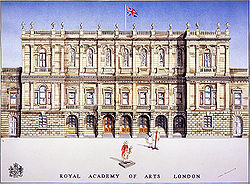
The Royal Academy of Arts (RA, traditionally written as R.A.) is an art institution based in Burlington House on Piccadilly in London. It has a unique position as an independent, privately funded institution led by eminent artists and architects; its purpose is to promote the creation, enjoyment and appreciation of the visual arts through exhibitions, education and debate.
The Royal Academy of Arts was founded through a personal act of King George III on 10 December 1768 with a mission to promote the arts of design in Britain through education and exhibition. The motive in founding the Academy was twofold: to raise the professional status of the artist by establishing a sound system of training and expert judgement in the arts, and to arrange the exhibition of contemporary works of art attaining an appropriate standard of excellence. Supporters wanted to foster a national school of art and to encourage appreciation and interest in the public based on recognised canons of good taste. Fashionable taste in 18th-century Britain was based on continental and traditional art forms, providing contemporary British artists little opportunity to sell their works.
_________________________________________
Piccadilly, London, United Kingdom
Fashionable taste in 18th-century Britain was based on continental and traditional art forms, providing contemporary British artists little opportunity to sell their works. From 1746 the Foundling Hospital, through the efforts of William Hogarth, provided an early venue for contemporary artists in Britain. The success of this venture led to the formation of the Society of Artists of Great Britain and the Free Society of Artists. Both these groups were primarily exhibiting societies; their initial success was marred by internal fractions among the artists. The combined vision of education and exhibition to establish a national school of art set the Royal Academy apart from the other exhibiting societies. It provided the foundation upon which the Royal Academy came to dominate the art scene of the 18th and 19th centuries, supplanting the earlier art societies.


The Royal Academy was initially housed in cramped quarters in Pall Mall, although in 1771 it was given temporary accommodation for its library and schools in Old Somerset House, then a royal palace. In 1780 it was installed in purpose-built apartments in the Strand in front of New Somerset House, designed by Chambers, the Academy's first treasurer. The Academy moved in 1837 to Trafalgar Square, where it occupied the east wing of the recently completed National Gallery (designed by another Academician, William Wilkins). These premises soon proved too small to house both institutions. In 1868, 100 years after the Academy's foundation, it moved to Burlington House, Piccadilly, where it remains.
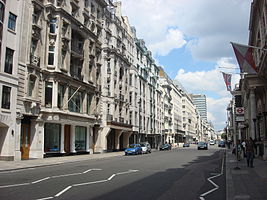
Pall Mall in 2009

Pall Mall was laid out in its present location in 1661, replacing a much older highway slightly to the south that ran from Charing Cross to St James's Palace (the residence of the king of England). This original alignment appears to have run from the Haymarket, at approximately the position of the current Warwick House Street, west-southwesterly to St James's Street, at the current position of Cleveland Row. The highway may have been in existence in Saxon times, although the earliest documentary references are from the 12th century in connection with St James's Hospital, a leper colony. When St. James's Park was laid out at the command of Henry VIII in the 16th century, the park's boundary wall was built along the south side of this earlier road. (In 1685, this alignment became the parish boundary for the Westminster St James parish.) In 1620, the Privy Council ordered the High Sheriff of Middlesex to clear "divers base sheddes and tentes sett up under St. James Park wall betweene Charinge Chrosse and St. James House, ... whiche are all offensive and noe way fitt to be suffered to stand."[1]

In 1630, the area's first court for playing pall-mall (a mallet-and-ball game similar to croquet and golf) was laid out north of the highway, in an area known as St. James's Field (later Pall Mall Field). Archibald Lumsden received a grant in September 1635 "for sole furnishing of all the malls, bowls, scoops, and other necessaries for the game of Pall Mall within his grounds in St. James's Fields and that such as resort there shall pay him such sums of money as are according to the ancient order of the game."[2]


Make a free website with Yola