The Journal of Crime & Punishment
Go back to page 1:
SOFTWARE PIRACY
Page 2
Dragonair was for a time China's largest airline, but is now one of three. It was started in 1985.
Editor,
Malcolm Baker,
Baker Publishing,
44 Spencer Avenue,
Maketu 3189,
NEW ZEALAND.

A picture of me posing with the Shaolin Monks wearing my Emperor's robe with the 14 navys of China on the sleeve.

A picture of me wearing the Shaolin Temple armband given to me by a member of the Temple. These cannot be bought, only earned, and each of the 17 beads is donated by a different trainer and presented at graduation. It shows a certain level of martial arts proficiency, such as the ability to break eight bricks with a single blow from the fist, and is an extremely prized possession.
My
opinion is that the internet is overpriced. I pay $75 per month from
Telecom, for 40Gb of data, and a landline. I don't need 40Gb, only 2-3
Gb. The cost should be $30 ($29.95) per month. The Commerce Commission
has said Chorus should
charge about $10 per month. I agree, although they could make profits at
a lot less. Also the speed. Copper lines can easily handle all the
speed I need. I do not need "superfast". If I use a web camera for
Skype- which I don't need to, and it goes too fast, I simply go through
more data, which I don't need.
Some of this may be none of your concern, however let me point out a few historical facts.
http://en.wikipedia.org/wiki/Optical_character_recognition#HistoryOptical character recognition, usually abbreviated to OCR, is the mechanical or electronic conversion of scanned or photographed images of typewritten or printed text into machine-encoded/computer-readable text. It is widely used as a form of data entry from some sort of original paper data source, whether passport documents, invoices, bank statement, receipts, business card, mail, or any number of printed records. It is a common method of digitizing printed texts so that they can be electronically edited, searched, stored more compactly, displayed on-line, and used in machine processes such as machine translation, text-to-speech, key data extraction and text mining. OCR is a field of research in pattern recognition, artificial intelligence and computer vision.
In 1978, Kurzweil Computer Products began selling a commercial version of the optical character recognition computer program. LexisNexis was one of the first customers, and bought the program to upload paper legal and news documents onto its nascent online databases. Two years later, Kurzweil sold his company to Xerox, which had an interest in further commercializing paper-to-computer text conversion. Xerox eventually spun it off as Scansoft, which merged with Nuance Communications.[citation needed]
A teleprinter (teletypewriter, Teletype or TTY) is an electromechanical typewriter that can be used to send and receive typed messages from point to point and point to multipoint over various types of communications channels. They were adapted to provide a user interface to early mainframe computers and minicomputers, sending typed data to the computer and printing the response. Some models could also be used to create punched tape for data storage (either from typed input or from data received from a remote source) and to read back such tape for local printing or transmission.
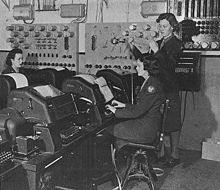
Teleprinters have largely been replaced by fully electronic computer terminals which usually use a computer monitor instead of a printer (though the term "TTY" is still occasionally used to refer to them, such as in Unix systems). Teleprinters are still widely used in the aviation industry (AFTN and airline teletype system), and variations called Telecommunications Devices for the Deaf (TDDs) are used by the hearing impaired for typed communications over ordinary telephone lines.
Most teleprinters used the 5-bit Baudot code (also known as ITA2). This limited the character set to 32 codes (25 = 32). One had to use a "FIGS" shift key to type numbers and special characters. Special versions of teleprinters had FIGS characters for specific applications, such as weather symbols for weather reports. Print quality was poor by modern standards. The Baudot code was used asynchronously with start and stop bits: the asynchronous code design was intimately linked with the start-stop electro-mechanical design of teleprinters. (Early systems had used synchronous codes, but were hard to synchronize mechanically). Other codes, such as ASCII, Fieldata and Flexowriter, were introduced but never became as popular as Baudot.
http://en.wikipedia.org/wiki/Optical_character_recognition#History
Optical character recognition, usually abbreviated to OCR, is the mechanical or electronic conversion of scanned or photographed images
of typewritten or printed text into machine-encoded/computer-readable
text. It is widely used as a form of data entry from some sort of
original paper data source, whether passport documents, invoices, bank
statement, receipts, business card, mail, or any number of printed
records. It is a common method of digitizing printed texts so that they
can be electronically edited, searched, stored more compactly, displayed
on-line, and used in machine processes such as machine translation, text-to-speech, key data extraction and text mining. OCR is a field of research in pattern recognition, artificial intelligence and computer vision.
In 1978, Kurzweil Computer Products began selling a commercial version of the optical character recognition computer program. LexisNexis
was one of the first customers, and bought the program to upload paper
legal and news documents onto its nascent online databases. Two years
later, Kurzweil sold his company to Xerox, which had an interest in further commercializing paper-to-computer text conversion. Xerox eventually spun it off as Scansoft, which merged with Nuance Communications.[citation needed]
http://en.wikipedia.org/wiki/JavaScript
JavaScript is a prototype-based scripting language with dynamic typing and has first-class functions. Its syntax was influenced by C. JavaScript copies many names and naming conventions from Java, but the two languages are otherwise unrelated and have very different semantics. The key design principles within JavaScript are taken from the Self and Scheme programming languages.[6] It is a multi-paradigm language, supporting object-oriented,[7] imperative, and functional[1][8] programming styles.
On the client side, JavaScript was traditionally implemented as an interpreted language but just-in-time compilation is now performed by recent (post-2012) browsers.
The application of JavaScript in use outside of web pages—for example, in PDF documents, site-specific browsers, and desktop widgets—is also significant. Newer and faster JavaScript VMs and platforms built upon them (notably Node.js) have also increased the popularity of JavaScript for server-side web applications.
http://en.wikipedia.org/wiki/Optical_character_recognition#History
Optical character recognition, usually abbreviated to OCR, is the mechanical or electronic conversion of scanned or photographed images
of typewritten or printed text into machine-encoded/computer-readable
text. It is widely used as a form of data entry from some sort of
original paper data source, whether passport documents, invoices, bank
statement, receipts, business card, mail, or any number of printed
records. It is a common method of digitizing printed texts so that they
can be electronically edited, searched, stored more compactly, displayed
on-line, and used in machine processes such as machine translation, text-to-speech, key data extraction and text mining. OCR is a field of research in pattern recognition, artificial intelligence and computer vision.
In 1978, Kurzweil Computer Products began selling a commercial version of the optical character recognition computer program. LexisNexis
was one of the first customers, and bought the program to upload paper
legal and news documents onto its nascent online databases. Two years
later, Kurzweil sold his company to Xerox, which had an interest in further commercializing paper-to-computer text conversion. Xerox eventually spun it off as Scansoft, which merged with Nuance Communications.[citation needed]
http://en.wikipedia.org/wiki/Optical_character_recognition#History
Optical character recognition, usually abbreviated to OCR, is the mechanical or electronic conversion of scanned or photographed images
of typewritten or printed text into machine-encoded/computer-readable
text. It is widely used as a form of data entry from some sort of
original paper data source, whether passport documents, invoices, bank
statement, receipts, business card, mail, or any number of printed
records. It is a common method of digitizing printed texts so that they
can be electronically edited, searched, stored more compactly, displayed
on-line, and used in machine processes such as machine translation, text-to-speech, key data extraction and text mining. OCR is a field of research in pattern recognition, artificial intelligence and computer vision.
In 1978, Kurzweil Computer Products began selling a commercial version of the optical character recognition computer program. LexisNexis
was one of the first customers, and bought the program to upload paper
legal and news documents onto its nascent online databases. Two years
later, Kurzweil sold his company to Xerox, which had an interest in further commercializing paper-to-computer text conversion. Xerox eventually spun it off as Scansoft, which merged with Nuance Communications.[citation needed]
Today, "JavaScript" is a trademark of Oracle Corporation.[31] It is used under license for technology invented and implemented by Netscape Communications and current entities such as the Mozilla Foundation.[32]
JavaScript and Sun.
The reference to Sun being an old Chinese company, and that Dragon is the parent company does not mean that the Emperor, (Dragon) is still in power in China. However, Dragon is still an international company.
Dragon Airlines is a Chinese company formed in Hong Kong, and many Dragonair employees work for the Chinese Government through the Chinese Government examination system.
Dragon (Naturally Speaking) is also speech recognition and voice to text, and series of teach yourself computer language suites
After the fall of the Qing in 1911, Dr. Sun Yat-sen, the leader of the newly risen Republic of China, developed similar procedures for the new political system through an institution called the Examination Yuan, one of the five branches of government, although this was quickly suspended due to the turmoil in China between the two world wars, such as the warlord period and the Japanese invasion. The Kuomintang administration revived the Examination Yuan in 1947 after the defeat of Japan. This system continues into present times in Taiwan along with the regime itself after loss of the mainland to the Communist Party of China.