The Journal of Crime & Punishment
Software PiracySOFTWARE PIRACY
Go back to:
The Journal of Crime & Punishment
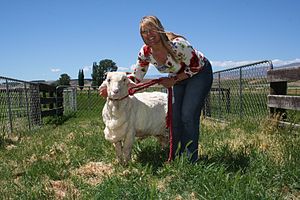
Shrek (c. 1994 – 6 June 2011) was a Merino wether (castrated male sheep) belonging to Bendigo Station, a sheep station near Tarras, New Zealand, who gained international fame in 2004 after he avoided being caught and shorn for six years. Merinos are normally shorn annually, but Shrek apparently hid in caves, avoiding muster. He was named after the fictional character in books and films of the same name.[1]
In 1990 at the Bay of Plenty Polytech we used the newly released (Microsoft) DOS 5 operating system, which wasn't officially released until 1991 (actually June or late 1990) (correction 1991), ( but we had machines running this software from the beginning of the year). Look at Wikipedia - DOS Operating Systems timeline for confirmation. I know a lot about this but you don't need to know for now, who did what first and where.
http://en.wikipedia.org/wiki/Timeline_of_DOS_operating_systems
1990 - 2000
1990 April Digital Research introduces DR DOS 5.0,[310] a DOS clone which is a strong competitor to MS-DOS 3.3 and 4.01. It includes the MemoryMax "memory manager", the first memory management system to allow loading TSRs, device drivers and the operating system into upper memory blocks, and the operating system to be loaded into the high memory area. Also, ViewMAX, a graphical front end functionally equivalent to MS-DOS 4.01's graphics shell.[311][312] It supports hard disk partitions up to 512 MB.
May Microsoft releases Windows 3.0, which would become the first widely successful version of Windows. Its File Manager became a popular alternative to the DOS Shell. Windows 3.0 runs on DOS 3.1 or higher.[315] This is the last version of Windows that could run on 8088 and 8086-based XT-class PCs (i.e., in real mode, which DOS runs in).
July Digital Research ships DR DOS 5.0 to retailers.[316] This was the first non-IBM version of DOS sold directly to end-users. About 40 percent of the nearly 7 million Intel-based PCs shipped this year will be shipped without an operating system, spelling big bucks for retail DOS sales.[317]
September IBM and Microsoft announce a realignment of their OS/2 development relationship.[319][320]
November IBM joins VESA and hands out copies of its XGA specification. The new standard comes as a blow to 8514/A manufacturers who spent three years reverse-engineering IBM's technology. Analysts say it would be difficult to modify XGA to work on ISA machines because XGA includes bus mastering.[325]
1991 March Microsoft said that it had received a letter in June from the Federal Trade Commission advising it of an investigation of its competitive practices, limited to the November 1989 joint announcement with IBM regarding OS/2. Some industry executives think the investigation will lead the FTC to a range of what they consider to be anti-competitive practices by Microsoft. Digital Research said that after it introduced its DR DOS version 5.0 in April 1990, Microsoft immediately announced a version of MS-DOS, with "amazing similarity," which has yet to appear.[310]
May IBM DOS 5 is released. It featured the moving of the DOS kernel and command.com into the high memory area.
1991 June Microsoft releases MS-DOS 5.0. The full-screen MS-DOS Editor is added to succeed Edlin. It adds undelete and unformat utilities, and task swapping. GW-BASIC is replaced with QBasic.[332]
Journal of Crime and Punishment 6th May 2014
It was the year my mother died, 1990, and I decided to occupy my mind by enrolling in a course at tne Bay of Plenty Polytrchnic, in Tauranga. The television skills course was full, but they had some vacancies in the CBC, (Certificate of Business Computing) course so I enrolled even though the class had already started a number of weeks ago. Greg Wagstaff was confident I would catch up. We had new computers, and a new computer suite. As far as I remember they were all running DOS-5. Anyway, I didn't finish the course, but I do remember spending about $12,000 on a new computer of my own, and Eclipse 386 (Intel 80386), 32 bit, running at about 20 or 25 MHz. I bought throug Greg, at the Polytec, and it came with a shrink wrapped copy of DOS-5, including the manual, which is about an inch thick, and has the Microsoft hologram on the spine. We'd been using the little McGraw-Hill Dos manual. Greg remarked to the class that my software was shrink wrapped.
It was also significant that that was the year I had an accident in my Mazda 323 while over the legal alcohol limit, and wrote it off. The day I was in court was the day Saddam Hussein invaded Kuwait. The invasion started on 2 August 1990. The result of losing my driver's licence was that I couldn't attend the course for the last part of the year, but I had my computer at home.
Some time after that I made contact with Dale, and he sent me a modem, with BitCom software, so I was then on the internet, such as it was. I'm not sure now wether that was teh same year, or a year later. I do remember that my computer stopped working after about a year, but that is another issue. I believe the chip ran a test for the new 3 1/2" floppy drives, and shut itself down after a specified time of not finding one installed, but it was diagnosed as a motherboard fault.
______________________________________________________________________________________________next page
1991 July Microsoft says they will no longer call a new operating system they are working on OS/2 3.0 — the new operating system will be named Windows NT (New Technology), which will not be able to run programs written for OS/2. Windows NT will be geared for more powerful computers and workstations, while a low-end version of Windows will run on top of MS-DOS.[335]
1992 June VESA outlines its VESA Local Bus specification, and Intel unveils its Peripheral Component Interconnect (PCI) spec.[341]
October Forbes ranks Microsoft chairman Bill Gates as America's richest person, topping its Forbes 400 list.[306]
1993 January Microsoft overtakes IBM in market capitalization. Each is valued at over $26 billion.[306]
March Microsoft introduces MS-DOS 6.0, including DoubleSpace disk compression.[342]
August A month after the Federal Trade Commission deadlocks for the second time with a 2-2 vote on whether to take action against Microsoft, the Justice Department officially notified Microsoft that it was proceeding with the case, ending the FTC's three-year investigation.[306]
November Microsoft replaces MS-DOS 6.0 with MS-DOS 6.2, leapfrogging IBM's PC DOS 6.1.[344] This version improved the stability of the included DoubleSpace disk compression.
1994 February Microsoft releases MS-DOS 6.21, removing DoubleSpace disk compression, due to a patent infringement lawsuit filed by Stac Electronics.
June Microsoft releases MS-DOS 6.22, bringing back disk compression under the name DriveSpace.
With the intent to create a "public domain" version of MS-DOS, Jim Hall announces the open-source project PD-DOS. Later, to ensure that the OS would remain free, the GNU General Public License is used to license code and the name is changed to FreeDOS.[345][346]
1995 August Windows 95 is released, launching the Windows 9x era. It comes with an MS-DOS -like bootloader reporting DOS version 7.0. All code is moved into IO.SYS, while MSDOS.SYS is now a text file containing bootup parameters.
1998 June Windows 98 is released. It also comes with MS-DOS 7.1, but now FAT32 support is available to any purchaser, not just OEM. Allows users to create an Emergency Boot Disk that boots into MS-DOS 7.1, which includes real-mode CD-ROM drivers and MS-DOS utilities used to access a malfunctioning Windows 98 installation. Due to the number of files that must fit on a 1.44MB 3.5" disk, a RAMDrive is created and a compressed CAB file is extracted into the RAMDrive upon bootup.[350]
1999 May Windows 98 Second Edition is released. It also comes with MS-DOS 7.1, which appears to be unchanged.
2000 September Windows Me is released, identifying itself as MS-DOS 8.0. This is the last version of MS-DOS, as future versions of Windows would be based on the Windows NT architecture.[351]